
Richard
Author
Share this article
For founders, product managers, and SaaS teams, listening to users is no longer optional. It is one of the most important parts of building a product people actually want.
Great products do not come only from the founder’s original idea. They come from continuously collecting feedback, understanding real customer needs, prioritizing the right features, sharing a clear roadmap, announcing product updates, and supporting users when they need help.
That is why tools like Canny.io, Nolt.io, and FeatureBase have become popular. They help teams collect feedback, let users vote on ideas, manage public roadmaps, and close the feedback loop after new features are released.
However, as a product grows, many teams face the same problem: software costs keep increasing, and every new need often requires another tool.
You may use one tool for feedback, another for changelogs, another for documentation, another for blogging, and another for live chat. The result is a messy stack of tools, scattered customer data, more subscriptions, and more operational work for a small team.
This is where Upwip.com becomes a strong alternative.
1. Canny.io
Canny is one of the most well-known tools in the product feedback space. It helps teams collect feature requests, allow users to vote on ideas, prioritize feedback, manage roadmaps, and publish changelogs.
The biggest strength of Canny is its maturity. The product is polished, the workflow is clear, and it works well for teams that already have a structured product feedback process.
Canny is a good fit for:
Founders who want a professional feedback portal.
Product teams that need to collect feature requests from customers.
SaaS teams that want to prioritize features based on user demand.
Teams that want to share a public roadmap with their customers.
However, for smaller teams or indie founders, Canny can become a heavy choice when your needs go beyond feedback and roadmap. If you also need docs, blog, live chat, or a complete product communication hub, you may still need to combine Canny with several other tools.
That means your total software cost can increase over time.
2. Nolt.io
Nolt is a simple and lightweight product feedback tool. Its biggest advantage is simplicity. Teams can quickly create a feedback board, let users submit ideas, vote on requests, and track the status of planned features.
Nolt is a good fit for:
Founders who want to get started quickly.
Small teams that need a simple feedback board.
Early stage products that want to collect ideas from users.
Teams that do not need a complex product feedback system.
If your main goal is to create a simple place where customers can submit feedback and follow a basic roadmap, Nolt is easy to use.
But its simplicity can also become a limitation. When your team needs changelogs, blog posts, documentation, a help center, or live chat, Nolt may not be enough to replace your full product communication stack.
For founders who want to reduce the number of SaaS tools they use, Nolt may only solve one part of the problem.
3. FeatureBase
FeatureBase is a more modern and broader product feedback platform. It expands beyond feedback and roadmap into changelogs, help center, support, and customer communication.
Its strength is how it connects feedback with what happens next. Teams can collect ideas, prioritize requests, update the roadmap, publish changelogs, and notify users when features are released.
FeatureBase is a good fit for:
SaaS teams that need a more powerful feedback system.
Teams that want to connect product feedback with support.
Growing companies that need a clearer customer communication workflow.
Teams that want more advanced features in one platform.
However, as a product becomes more powerful and serves larger teams, pricing and complexity can also increase. For indie founders, small startups, or teams trying to keep costs under control, a heavy platform may feel like more than they actually need.
4. Upwip.com: The Perfect Alternative for Founders and Product Teams
Upwip.com is built for founders and product teams that want to manage the full product feedback loop in one simple platform.
Instead of focusing only on feedback or roadmap, Upwip combines multiple essential modules in one place:
Feedback to collect ideas and suggestions from users.
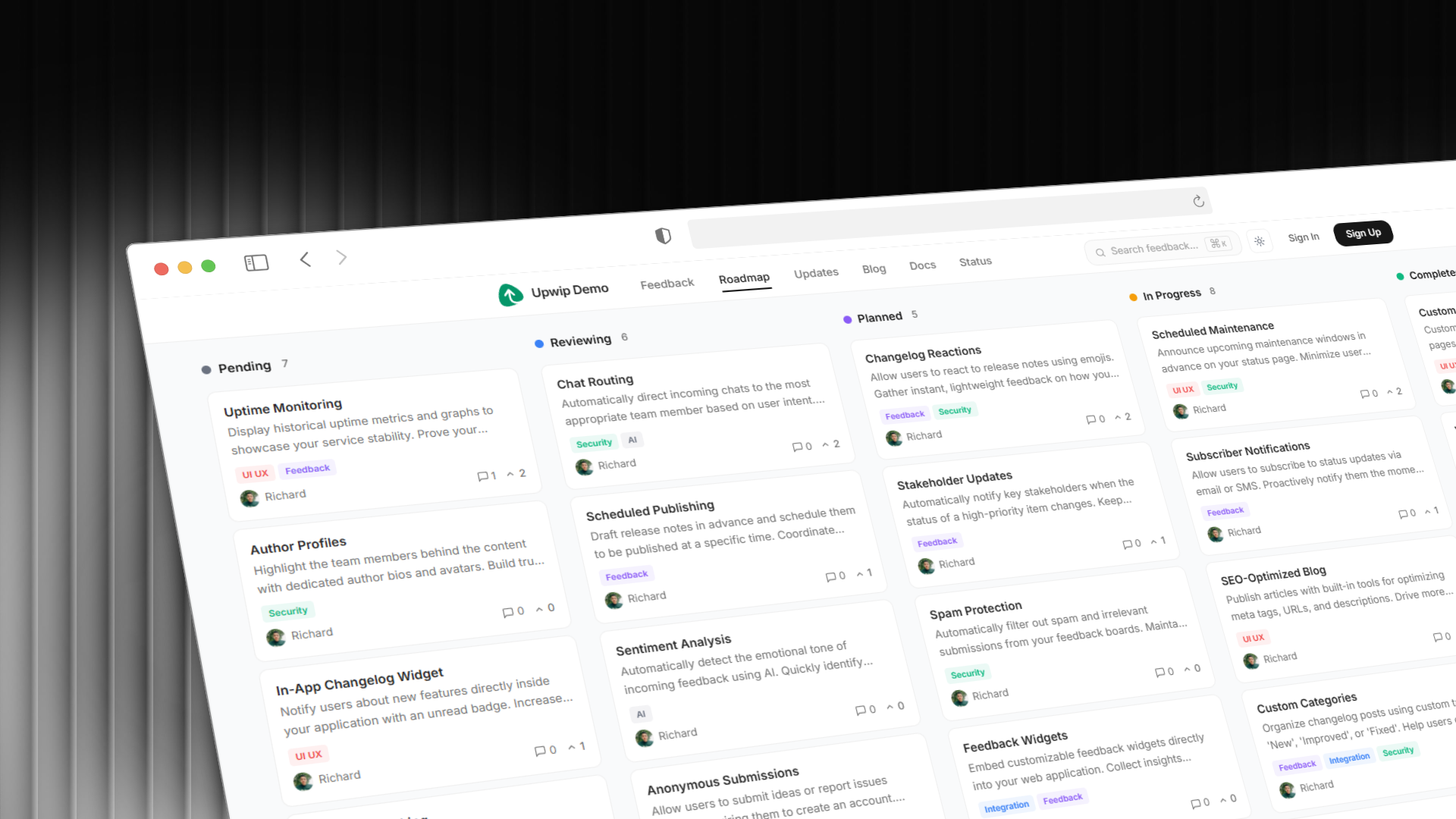
Roadmap to share what your team is building next.
Changelog to announce product updates and new releases.
Blog to publish product stories, guides, and SEO content.
Docs to create helpful documentation for users.
Live chat to support customers when they need help.
The biggest difference is that Upwip helps founders avoid stitching together too many separate tools. A small team can start with feedback, turn ideas into roadmap items, publish changelogs after releases, write docs to reduce repeated support questions, create blog content for SEO, and support customers through live chat.
Everything works together in one platform.
This matters a lot for SaaS founders. In the early stages, founders often have to do everything: build the product, talk to users, manage feedback, update the roadmap, write content, publish release notes, and support customers.
If every job requires a separate tool, both cost and complexity grow quickly.
Upwip helps reduce that complexity.
5. Canny vs Nolt vs FeatureBase vs Upwip
Canny is a strong choice for product feedback and roadmap. It works well for teams that want a mature and specialized platform for understanding customer needs.
Nolt is a simple choice for feedback boards. It works well for small teams that want something lightweight and easy to launch.
FeatureBase is a broader solution with feedback, roadmap, changelog, help center, and support features. It works well for growing teams that need a more complete customer communication system.
Upwip is the all-in-one alternative for founders and product teams that want more than feedback and roadmap. It includes feedback, roadmap, changelog, blog, docs, and live chat, helping teams reduce costs, simplify their workflow, and manage product communication from one place.
6. Why Founders Should Consider Upwip Instead of Using Many Separate Tools
For a growing SaaS product, software costs often increase quietly.
At first, you only need a feedback tool. Then you need a changelog tool. Then a docs platform. Then a blog. Then live chat. Then a roadmap tool. Each product has its own subscription, interface, data, and workflow.
The problem is not only the cost.
The bigger problem is fragmentation.
Feedback lives in one place. Roadmap lives somewhere else. Docs are managed in another tool. Changelogs are published from another system. Customer questions come through live chat somewhere else.
Founders and product teams are forced to switch between tools, copy information manually, and keep everything in sync.
Upwip solves this by bringing the most important parts of product communication into one platform.
When a user submits feedback, your team can turn it into a roadmap item. When the feature is released, you can publish a changelog. When the feature needs explanation, you can write docs. When you need long-term content, you can publish blog posts. When users need help, you can support them with live chat.
This is a more natural workflow for modern product teams.
7. Who Is Upwip Best For?
Upwip is a great fit for indie founders building SaaS products and trying to keep software costs low.
It is also useful for small startups that need one place to manage feedback, roadmap, changelog, blog, docs, and live chat.
Product teams that want to listen to users better without managing too many separate tools can also benefit from Upwip.
It is especially relevant for teams currently using Canny, Nolt, or FeatureBase but looking for a simpler, more affordable, and more integrated alternative.
Upwip is also a strong choice for founders who want to build in public, stay transparent with users, and create a closer relationship with their customers.
8. Final Thoughts
Canny, Nolt, and FeatureBase are all good products in the product feedback and roadmap space. Each one has its own strengths and can be the right choice depending on your team’s needs.
But for founders and product teams looking for a simpler, more cost-effective, and more integrated alternative, Upwip.com is worth considering.
Instead of solving only one part of the product feedback process, Upwip helps teams manage the full journey: collecting user feedback, prioritizing features, sharing a public roadmap, publishing changelogs, writing documentation, creating blog content, and supporting customers with live chat.
As SaaS tools become more expensive and fragmented, an all-in-one platform like Upwip helps founders focus on what matters most: building products users actually love.