

Richard
Author
Share this article
Great products don't just ship features. They communicate direction.
A product roadmap isn't a promise of every feature you'll build. It's a communication tool that aligns your team, sets customer expectations, and demonstrates your long term vision.
Unfortunately, many roadmaps become little more than feature wishlists filled with vague ideas and unrealistic deadlines. The result is confusion, disappointment, and lost trust.
Here are eight proven best practices to build a roadmap that is clear, transparent, and genuinely valuable for both your team and your users.
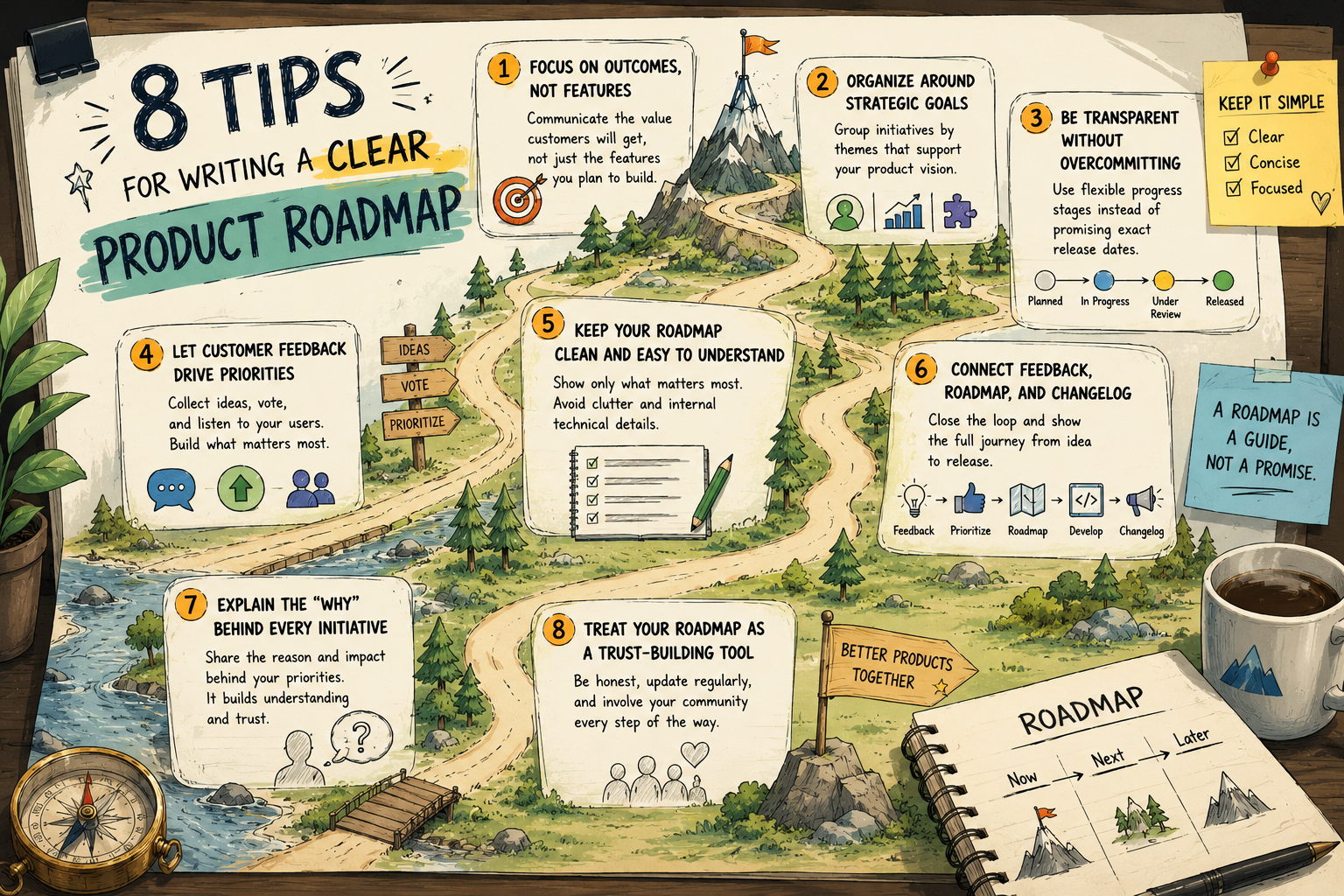 1. Focus on Outcomes, Not Features
One of the biggest mistakes companies make is treating their roadmap like a feature list.
Instead of:
- AI Assistant
- Dark Mode
- CSV Export
- Help teams make decisions faster
- Simplify daily workflows
- Improve collaboration across departments
- Faster onboarding
- Better navigation
- Mobile optimization
- Workflow automation
- Performance improvements
- Bulk actions
- Slack
- Zapier
- Google Workspace
- Planned
- Under Review
- In Progress
- Released
- Now
- Next
- Later
- Submit ideas
- Vote on requests
- Leave comments
- Share real world use cases
- Hundreds of tickets
- Technical implementation details
- Minor bug fixes
- Low level engineering tasks
- What people are requesting
- What the team is working on
- What has already been delivered
- Requested by enterprise customers
- Improves security and compliance
- Simplifies organization wide adoption
- Honest
- Frequently updated
- Easy to understand
- Community driven
- Focused on value
- Connected to real product progress
Frame your roadmap around the value customers will receive:
Customers don't buy features. They buy better outcomes.
When your roadmap communicates impact rather than implementation, it becomes much more meaningful.
2. Organize Around Strategic Goals
A roadmap should tell a story, not present a random collection of tasks.
Group initiatives under themes such as:
Improve User Experience
Increase Productivity
Expand Integrations
Strategic grouping helps customers and internal teams understand where the product is heading instead of getting lost in technical details.
3. Be Transparent Without Overcommitting
Predicting exact release dates months in advance is rarely realistic.
Rather than publishing rigid deadlines, use flexible progress stages such as:
Or even simpler:
Transparency builds trust, while unnecessary promises often create frustration.
Your roadmap should communicate priorities, not guarantee timelines.
4. Let Customer Feedback Drive Priorities
The best product decisions aren't made in isolation.
Create a continuous feedback loop where customers can:
Instead of guessing what users want, let data and community participation guide your priorities.
When customers see their voices influencing the roadmap, engagement and loyalty naturally increase.
5. Keep Your Roadmap Clean and Easy to Understand
A roadmap is not your internal backlog.
It shouldn't contain:
Instead, highlight only the initiatives that matter most.
A simple roadmap is easier to maintain, easier to communicate, and far more useful for customers.
Remember: clarity always beats complexity.
6. Connect Feedback, Roadmap, and Changelog
Many companies treat these as separate systems.
The best teams connect them into one continuous product lifecycle:
Customer Feedback → Voting → Prioritization → Roadmap → Development → Release → Changelog
This creates complete transparency.
Users can see:
That visibility creates confidence and strengthens customer relationships over time.
7. Explain the "Why" Behind Every Major Initiative
People are much more likely to support decisions when they understand the reasoning behind them.
Instead of simply listing:
Single Sign On
Provide context:
Sharing the motivation behind your priorities helps customers understand your strategy instead of questioning it.
8. Treat Your Roadmap as a Trust Building Tool
Your roadmap isn't a marketing page.
It's an ongoing conversation between your team and your customers.
The best roadmaps are:
Customers don't expect perfection.
They expect transparency, consistency, and evidence that their feedback genuinely matters.
Final Thoughts
A clear product roadmap does far more than organize future work. It creates alignment inside your company and builds credibility with your customers.
When combined with a public feedback board, feature voting, and a transparent changelog, your roadmap becomes the central hub of your product communication strategy.
With Upwip, teams can collect feedback, prioritize ideas, publish public roadmaps, and share product updates in one unified platform, creating a more collaborative and customer driven product development process.