
Richard
Author
Share this article
Looking for the best Featurebase alternatives in 2027?
Featurebase is a popular platform for collecting customer feedback, managing feature requests, building product roadmaps, and communicating product updates. It can be a useful solution for SaaS companies that want to understand what customers need and keep users informed about product development.
However, Featurebase isn't the perfect fit for every company.
You may be looking for a simpler tool, more customization, a different pricing model, more product communication features, or an all-in-one platform that combines feedback, roadmaps, changelogs, documentation, and blogs.
In this guide, we'll explore 10 Featurebase alternatives worth considering in 2027 and explain what each platform is best suited for.
What Is Featurebase?
Featurebase is a customer feedback and product management platform built for SaaS companies and digital products.
It helps teams collect feedback, organize feature requests, allow customers to vote on ideas, publish product roadmaps, and communicate product updates.
The basic workflow is straightforward:
Customers submit feedback or feature requests, other users can interact with those requests, product teams review and prioritize them, and customers can follow the progress of ideas.
For growing SaaS companies, this can provide a centralized place for customer feedback and product communication.
However, some teams may need more than a feedback and roadmap platform.
They may also want documentation, blogs, changelogs, customer support, or other customer-facing content in the same platform.
That's where Featurebase alternatives become interesting.
What Should You Look for in a Featurebase Alternative?
Before choosing an alternative, consider how your team currently collects feedback and communicates with customers.
Customer Feedback
A good alternative should make it easy for customers to submit feedback and product ideas.
The process should be simple enough that users don't need to contact your support team every time they have a suggestion.
Feature Requests
Feature requests help product teams organize customer ideas and understand what users want.
Look for tools that allow requests to be categorized, discussed, prioritized, and tracked.
Feature Voting
Voting allows customers to support existing requests.
This can help teams identify requests that have broader customer interest.
Public Roadmap
A public roadmap lets customers see what you're planning to build.
It can also help set expectations and make product development more transparent.
Changelog
A changelog is useful for communicating what has already been shipped.
Instead of only showing customers what is coming next, you can also show them what has recently changed.
Documentation
Some SaaS companies want their feedback platform to be part of a larger customer knowledge base.
If you already use another tool for documentation, an alternative that includes docs can potentially simplify your stack.
Customization
Your feedback portal should ideally feel like part of your product.
Custom branding, domains, layouts, and content can make the experience more consistent for your customers.
Pricing
Pricing is another important factor.
The right platform depends on your budget, team size, number of users, and the number of products or workspaces you need to manage.
10 Best Featurebase Alternatives in 2027
Here are 10 Featurebase alternatives worth considering in 2027.
1. Upwip
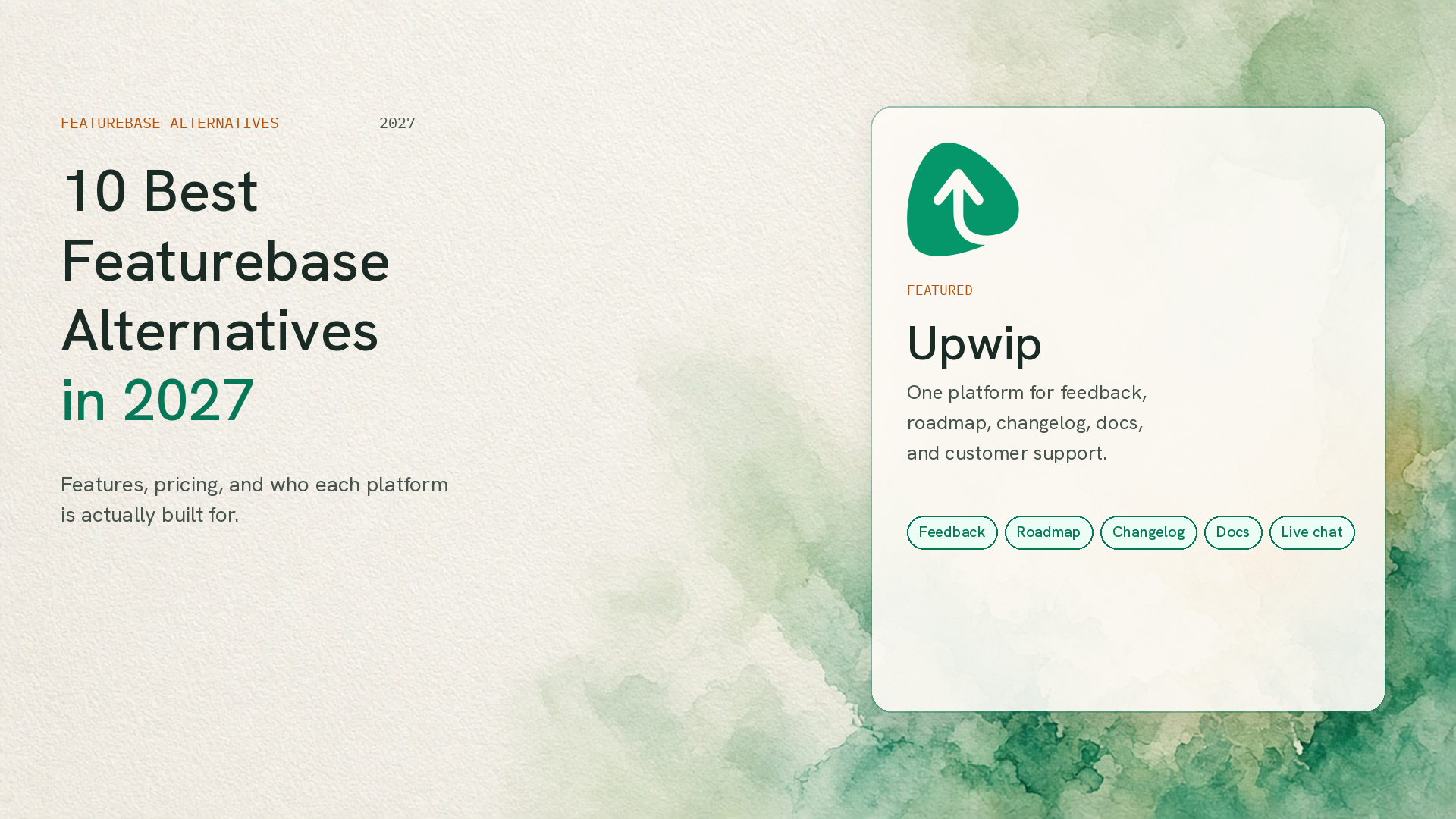
Upwip is an all-in-one customer feedback and product communication platform designed for SaaS companies.
Instead of focusing only on feedback and roadmaps, Upwip brings several customer-facing workflows together.
With Upwip, teams can:
- Collect customer feedback
- Manage feature requests
- Allow customers to vote on ideas
- Create public roadmaps
- Publish changelogs
- Create documentation
- Write product blogs
- Communicate product updates
- Support customers
- Use live chat
- Customize their customer-facing experience
- Pricing
- Number of users
- Number of feedback boards
- Custom domains
- Branding
- Integrations
- API access
- Automation
- AI features
- Documentation
- Changelog
- Blog
- Customer support
- Data migration
- What features are being requested?
- Which features are being considered?
- What is currently being built?
- What has already shipped?
- Where can they find documentation?
- How can they contact the team?
- How can they submit feedback?
This makes Upwip particularly useful for SaaS founders and product teams that want to reduce the number of separate tools they use to communicate with customers.
Why consider Upwip instead of Featurebase?
Featurebase can be a good choice if your main requirement is customer feedback, feature requests, and product roadmaps.
But some teams need a broader customer-facing platform.
If your workflow includes feedback, roadmap, changelog, documentation, blog content, and customer communication, having these capabilities in one platform can make your product communication workflow simpler.
Upwip is designed around this broader workflow.
You can collect feedback from customers, communicate what you're building through a public roadmap, announce shipped features through changelogs, and provide supporting content through documentation and blogs.
2. Canny
Canny is one of the most well-known platforms in the customer feedback space.
It allows companies to collect feedback, manage feature requests, let customers vote on ideas, and share product roadmaps.
Canny is particularly relevant for teams looking for a dedicated feedback management platform.
If you're comparing Canny and Featurebase, consider the differences in pricing, customization, integrations, roadmap functionality, and the other product communication features you need.
Canny is also one of the most common alternatives considered by teams researching Featurebase competitors.
3. Nolt
Nolt is a feedback management platform focused on feature requests and customer voting.
Users can submit ideas, vote on existing requests, and follow product development.
Its relatively focused approach can work well for SaaS companies that want a straightforward feedback portal without adopting a larger product management platform.
If your requirements extend to documentation, blogs, and broader customer communication, you may want to compare Nolt with more comprehensive alternatives.
4. Frill
Frill combines customer feedback, feature requests, roadmaps, and product updates.
It is designed for companies that want to collect customer ideas and communicate product development in one place.
Frill can be an option for SaaS teams that want something relatively lightweight compared with larger product management platforms.
When evaluating Frill as a Featurebase alternative, look at feedback management, roadmap functionality, changelogs, customization, integrations, and pricing.
5. UserVoice
UserVoice is an established customer feedback and product management platform.
It provides tools for collecting customer feedback and helping product teams organize and prioritize customer needs.
UserVoice is often associated with larger organizations and more structured product feedback workflows.
For smaller SaaS companies, a simpler alternative may be more appropriate depending on their requirements.
6. Upvoty
Upvoty is focused on collecting customer feedback, feature requests, and votes.
The platform provides a straightforward workflow where customers can submit ideas and vote on existing requests.
It can be a good option for companies that primarily need a feedback and feature voting system.
Teams looking for a broader platform should compare its capabilities with alternatives that include documentation, changelogs, blogs, and other customer communication features.
7. Productboard
Productboard takes a broader product management approach.
It helps product teams collect customer insights, organize product ideas, prioritize opportunities, and plan product development.
Compared with dedicated feedback platforms, Productboard is more focused on internal product management and planning.
It can be useful for larger product organizations that need structured product workflows.
8. Fider
Fider is an open-source customer feedback platform.
It allows users to submit ideas and vote on suggestions.
Because it is open source, Fider can be interesting for teams that want to self-host their feedback platform and have more control over their infrastructure.
However, self-hosting also means that your team is responsible for deployment, maintenance, updates, backups, and security.
9. Beamer
Beamer focuses on product announcements, customer communication, engagement, and feedback.
It can be useful for companies that want to communicate new features and updates directly to users.
If you're comparing Beamer with Featurebase, consider whether your main requirement is collecting feedback, managing feature requests, publishing roadmaps, or communicating product updates.
10. Feature Upvote
Feature Upvote is focused primarily on feature requests and voting.
The concept is simple: customers submit feature ideas and other users can vote on them.
It can be suitable for teams that want a focused feature voting platform without adopting a larger product management system.
Featurebase Alternatives for Different Use Cases
Not every team needs the same type of product feedback platform.
The right Featurebase alternative depends on what you're trying to accomplish.
For customer feedback
If your primary goal is collecting and organizing customer feedback, platforms such as Upwip, Canny, Nolt, Frill, and Upvoty are worth considering.
For feature voting
If voting is the most important workflow, simpler platforms such as Nolt, Upvoty, and Feature Upvote may be worth evaluating.
For product management
If you need deeper internal product planning and prioritization, Productboard and UserVoice may be more appropriate.
For public roadmaps
If transparency is a major priority, look for a platform that provides a strong public roadmap experience.
Upwip, Featurebase, Canny, Nolt, and Frill all approach public product communication from slightly different directions.
For an all-in-one SaaS platform
If you want feedback, roadmaps, changelogs, documentation, blogs, and customer communication together, an all-in-one platform such as Upwip can be worth considering.
Featurebase vs Canny
Featurebase and Canny are often compared because both are designed around customer feedback and product development.
Both can help companies collect feature requests, gather votes, and communicate product roadmaps.
The main differences you'll want to investigate are pricing, customization, integrations, user experience, roadmap functionality, and the broader set of customer communication features.
If your needs are primarily centered around feedback and feature requests, either type of platform may work.
If you need a broader product communication system, look beyond the feedback board itself and evaluate how each platform handles changelogs, documentation, blogs, and customer communication.
Featurebase vs Upwip
Featurebase and Upwip have overlapping use cases around customer feedback, feature requests, and product roadmaps.
The main difference is the broader scope of the platforms.
Featurebase focuses strongly on customer feedback and product communication.
Upwip is designed as a broader SaaS customer communication platform that combines feedback with roadmaps, changelogs, documentation, blogs, and customer support.
For a SaaS company that wants to centralize more of its customer-facing product communication, this broader approach may be worth considering.
The best choice depends on which workflows your team actually needs.
How to Choose the Right Featurebase Alternative
Before switching from Featurebase, write down the workflows your team currently uses.
For example:
Customer feedback → Feature requests → Voting → Roadmap → Product development → Changelog → Documentation → Customer support
Then identify which parts of this workflow are currently handled by Featurebase and which require other tools.
You should also consider:
This will give you a clearer idea of whether you need another dedicated feedback tool or a broader platform.
Why SaaS Companies Look for Featurebase Alternatives
As SaaS products grow, customer communication becomes more complicated.
Customers want to know:
Managing all of these workflows across several disconnected tools can create unnecessary complexity.
This is why some SaaS companies look for platforms that combine multiple product communication workflows.
Instead of having one tool for feedback, another for roadmaps, another for changelogs, another for documentation, and another for customer communication, an all-in-one platform can provide a more centralized experience.
Final Thoughts
Featurebase is a useful option for SaaS companies looking to collect customer feedback, manage feature requests, and communicate product development.
But there are many Featurebase alternatives available in 2027.
Canny, Nolt, Frill, Upvoty, UserVoice, Productboard, Fider, Beamer, and Feature Upvote all approach customer feedback and product communication differently.
For SaaS companies looking for a broader customer-facing platform, Upwip combines feedback, feature requests, public roadmaps, changelogs, documentation, blogs, and customer communication in one place.
The right Featurebase alternative depends on your team's workflow, budget, product complexity, and the experience you want to provide to customers.
Instead of choosing a platform based only on its feature list, focus on the complete workflow your customers and product team need to support.